Are These The Dog Days of Summer… or a Market That’s Quietly Changing?
What July’s Coachella Valley Housing Market is Really Telling Us
Every month I hear the same question: “So…are we in a buyer’s market or a seller’s market?”
It’s a fair question, but I think it’s the wrong question. If you’ve been waiting for me to declare, “It’s officially a buyer’s market.” or… “Sellers are back in charge.” …I’m afraid I’m going to disappoint you.
The truth is, markets rarely announce when they’re changing. They don’t ring an opening bell, or issue a press release.
Most of the time, a shift is gradual – and most people only recognize it looking in the rearview mirror.

Markets Leave Clues.
The question isn’t whether the clues are there. The question is whether we’re paying attention. The July numbers tell an interesting story
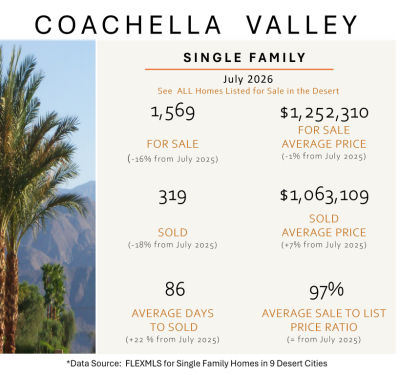
At first glance, they almost seem contradictory. Across the Coachella Valley, there are fewer homes for sale than there were a year ago, and fewer homes sold.
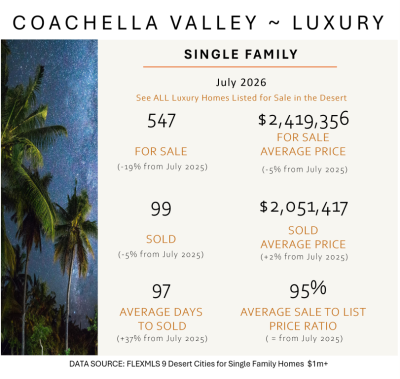
At the same time, homes are taking noticeably longer to sell, yet sellers received 95% and 97% of their asking price.
So…Is demand weakening? Not necessarily. One of the most useful ways to measure the heartbeat of a market is the absorption rate.
It tells us how quickly the market is absorbing the available inventory.
- If inventory is growing faster than buyers are purchasing (absorbing) homes, the market is slowing.
- If buyers are purchasing homes as quickly as new inventory arrives, the market remains healthy and balanced.
- If buyers are absorbing inventory faster than new inventory enters the market – (think COVID), then the market is accelerating.
This is where trends are revealed.
What July’s Absorption Rates Reveal
This year’s numbers were surprisingly consistent.
Valley-wide Single-Family Homes
Despite fewer homes selling overall, the pace that buyers are purchasing available inventory improved slightly. Moving the market to a 4.7 month supply.
Luxury Homes
Luxury was the surprise. Inventory dropped significantly from one year ago, while the number of homes sold remained virtually unchanged. The absorption rate rose to 20% moving inventory to a 5-month supply. That’s not the profile of a weakening luxury market. It’s actually a healthier story.
Condominiums
The condominium market may be the steadiest of all. Almost identical to last July, showing remarkable stability.
Market Signals – The forces behind today’s market activity.
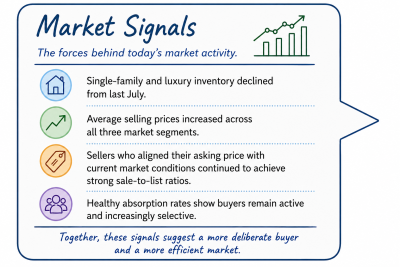

The July numbers suggest a market that continues to reward sellers who adapt to current conditions. Many successful sales involved price adjustments from the original asking price, but once a home is positioned where today’s buyers see value, negotiations become much smaller. Across all three market segments, homes sold for 95% to 97% of their current asking price, indicating that today’s pricing decisions are happening before the first offer is written—not at the negotiating table.
While buyers remain selective and are taking longer to make decisions, they’re still willing to pay near asking price for homes that are well-priced and well-presented. The market isn’t rewarding wishful pricing, but it is rewarding sellers who recognize today’s conditions and respond accordingly.
So Why Does the Market Feel Different?
This is where statistics stop answering questions. And experience begins.
Over the years, I’ve seen many changes, and after more than twenty years walking through homes with buyers across the Coachella Valley, I’ve learned something the numbers alone can’t explain.
The change I see happening now is significant; it wasn’t that long ago buyers walked into a home looking for reasons to buy it. Today, many arrive looking for reasons to move on. Not because they’ve become impossible to please. Because they no longer feel pressured to settle.
They have choices, and choice changes behavior.
When buyers feel urgency, they’re willing to compromise. When buyers have options, they become more thoughtful. More intentional.
They’re no longer asking, “Can we make this work?” More often they’re asking, “Is this the best home available for the money?”
It’s a subtle difference. But it changes everything.
Every Listing Is Competing for One Decision
One of the biggest misconceptions in today’s market is that homes compete against market conditions.
They don’t. They compete against one another. Every listing is asking buyers the exact same question. Why should you choose this home instead of the next one?
That’s a much higher standard than many sellers have experienced in recent years.
The statistics tell us what happened. Watching buyers, tells us why. The first showing begins long before an appointment is scheduled; buyers have already compared dozens of homes online and eliminated most. Saved a handful. Compared them again. Shared them with family. Eliminated a few more.
By the time they arrive for an in-person showing, your home has already survived several rounds of competition.
That’s a significant change.
The in-person showing doesn’t start the competition. It continues it.

The Quiet Shift
Over the years, I’ve seen many changes – the change I see happening now is significant; it wasn’t that long ago buyers walked into a home looking for reasons to buy it. Today, they’re more likely to arrive asking a different question.
“Is this the best home available?”

This is an important distinction. Not because buyers have become unreasonable. And not because the market suddenly favors buyers. It’s because today’s buyers have enough opportunity to compare homes before making one of the largest financial decisions of their lives.
That naturally changes expectations. It changes how carefully buyers assess value. It changes how they compare one home against another. And it changes how long they’re willing to think before writing an offer.
The market didn’t change overnight—the buyer did.
Why Homes Are Taking Longer to Sell
This may be the biggest clue July left behind. Yes, homes are taking longer to sell, but buyers are still paying remarkably close to asking price.
Those two facts are not contradictory. They’re connected.
Healthy absorption rates tell us the market is functioning well. Longer marketing times tell us buyers are taking longer to choose. Strong sale-to-list ratios tell us they’re still willing to pay for the right home. Buyers aren’t negotiating deeper discounts dramatically. They’re simply becoming more selective about which home earns their offer.
When the right home comes along, they’re still willing to pay for it. That’s why sale-to-list price ratios remain so strong.
It’s also why absorption rates remain healthy.
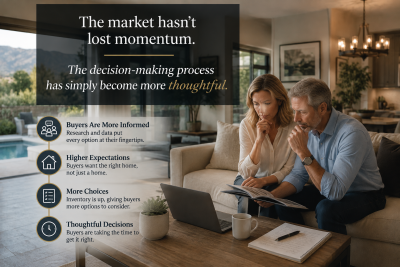
The market hasn’t lost momentum. The decision-making process has simply become more thoughtful.
The Clue July Left Behind
The story is that the market continues to function remarkably well. Homes are selling. Inventory is being absorbed at a healthy pace, and Sellers continue to receive close to their asking price.
But buyers are making those decisions differently than they have in the recent past.
That’s the clue. And I suspect it’s one we’ll continue to see for some time.
While markets don’t announce when they’re changing, they do leave clues. The numbers tell us what happened. Buyer behavior helps explain why.
Understanding both is where informed decisions begin.
- Healthy absorption rates tell us the market is still functioning well.
- Longer marketing times tell us buyers are taking more time to decide.
- Strong sale-to-list ratios tell us they’re still willing to pay for the right home.
Put those three clues together, and a different picture emerges— The market isn’t sending conflicting signals. It’s revealing that buyers are approaching the decision differently than they have in recent years.
Explore Community Market Reports
While this article looks at trends across the Coachella Valley housing market, every community has its own story.
Explore the latest market reports for:
Frequently Asked Questions
Is the Coachella Valley housing market currently a buyer’s market or a seller’s market?
July’s market doesn’t fit neatly into either category. Absorption rates remain healthy, sellers continue receiving 95% to 97% of their asking price, and inventory is being absorbed at a balanced pace. Rather than signaling a dramatic shift in market power, the data points to buyers making more thoughtful decisions before writing an offer.
What is an absorption rate, and why does it matter?
The absorption rate measures how quickly available homes are selling. Think of it as the market’s heartbeat. Healthy absorption rates indicate that buyers are actively purchasing homes, while months of supply help determine whether the market is balanced or beginning to favor buyers or sellers. It’s one of the most useful indicators because it measures the relationship between supply and demand.
If homes are taking longer to sell, why are sellers still receiving nearly full asking price?
This is one of July’s most interesting clues. Longer days on market suggest buyers are spending more time comparing homes before making a decision. Yet when they find the property that offers the best overall value, they’re still willing to pay close to asking price. Those two statistics aren’t contradictory—they reveal a buying process that has become more deliberate.
What does this mean if I’m thinking about selling my home?
Today’s buyers often begin evaluating homes online long before scheduling a showing. By the time they walk through your front door, your home has already survived several rounds of comparison. Professional presentation, strategic pricing, and thoughtful preparation are more important than ever because buyers are comparing every opportunity before deciding which home deserves their offer.
About the Author
Cathi Walter is a Broker Associate and LUXE Director with Bennion Deville Homes, specializing in residential and luxury real estate throughout the Coachella Valley.
For more than 20 years, she has helped buyers and sellers make informed real estate decisions by combining market analysis, pricing strategy, and firsthand experience to interpret what the market is really saying.
Desert Living Online is Cathi Walter’s monthly publication dedicated to helping homeowners, buyers, and sellers better understand the Coachella Valley real estate market. Every month, Desert Living Online goes beyond the headlines to explore what the numbers mean, how buyers are really behaving, and the trends shaping real estate across the Coachella Valley. It’s written for those who want more than statistics—they want perspective.


